
Reflexology and Autism Spectrum Disorder
Reflexology can be an interesting method in the comprehensive support of autism spectrum disorder. People with Autism Spectrum Disorder are cared for by many professionals—psychologists, occupational therapists—depending on their personal situation. Reflexology is rarely part of the equation, and I find that regrettable.
I have had the privilege of supporting adults (mostly) who were diagnosed quite late, who therefore were not necessarily supported in an appropriate manner from a young age and who developed many coping mechanisms to be socially accepted.
In this article, I will speak only of my personal experience in the practice; this is not intended to be a universal statement.
Why Reflexology and Autism Spectrum Disorder?
Among the adults with ASD who came for treatments at the practice and whom I was able to support over several months, even years, the primary objective for the majority was to reconnect with their body. Very intellectual, heavily solicited verbally, or particularly isolated due to different behavior or significant sensitivity, these individuals were very rarely touched or hugged. For most, they avoided contact, feeling uncomfortable or frankly disturbed. As part of their personal work, the question of the body came to the table and that is how they arrived at the practice.
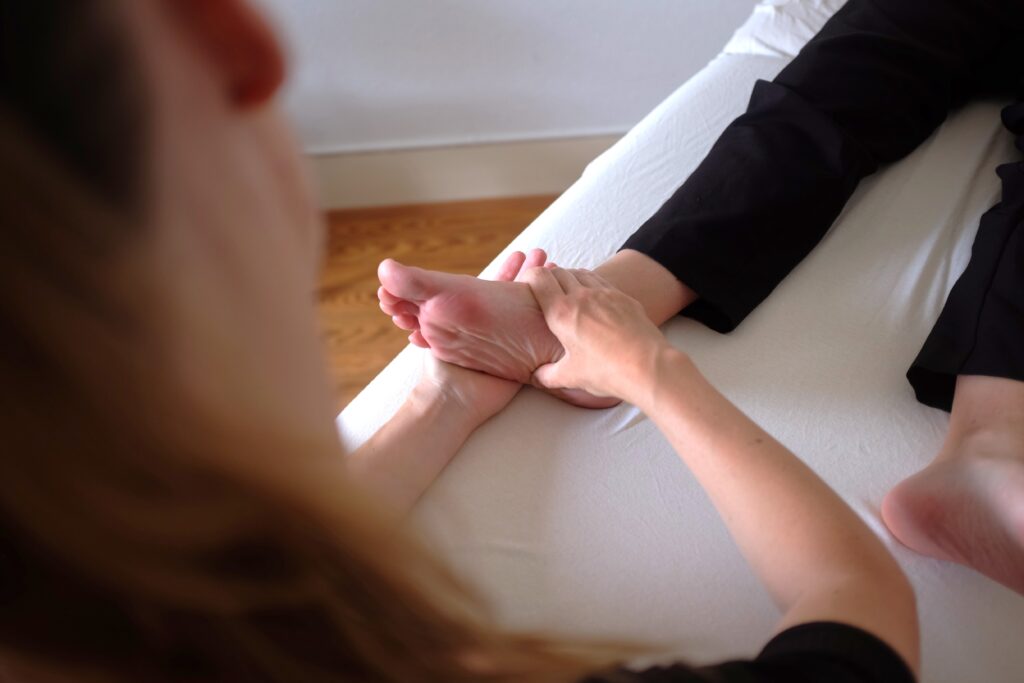
Reflexology is a non-invasive method that involves massage of the feet primarily (but it can also be massage of the hands, head, ears, or face). The touch can be more or less deep, depending on the reflex zones and each person’s sensitivity, and massage of the reflex zones encourages overall rebalancing of the body.
During the session, the person may experience sensations of warmth, tingling, stomach gurgling (and many other sensations). All these sensations are interesting to observe, to feel, because they encourage listening to one’s own body. Throughout the sessions, I encourage awareness of pleasant and less pleasant sensations (certain reflex zones are sensitive, even painful) in constant dialogue with the person being massaged.
For a detailed article on reflexology, please click on the link above.
When one is not comfortable with touch, a therapist who touches only the feet can be an interesting approach. The reflexologist is far from the head, touching only a small part of the body, clearly defined together with the person being massaged. Consent is paramount! And it is a method that evolves with the patient’s state of mind. Once more comfortable and when the person feels ready, we can always massage the hands or ears!


How Can Reflexology Support People with ASD?
Preparing for the First Appointments
Before the first appointment, I will prepare as many visual tools as possible so that the person can anticipate subsequent appointments without fear.

First Session Process
The first session allows me to get to know the person, understand their need, introduce myself, and explain how I work. I emphasize that I ask for consent to touch each part of the body, that I do nothing without the patient’s agreement. I explain the different methods I use that allow me to adapt to the person in front of me.
I show the different rooms in the practice so that there are no surprises if the next session takes place in another room.
During the treatment, if it is necessary and reassuring for the person, I will explicitly say “I am going to work on the left/right foot, the toes…” I have done this for 2 sessions and then the person indicated they no longer needed it; I have continued longer at other times. Once again, I adapt! Whether with people without or with ASD, needs and requests are always unique to each individual, and it is my job to find the means to achieve a result as effectively as possible while respecting what the person wishes.
ASD and Medicine
Reflexology in no way replaces traditional medicine in supporting people. The individuals I have supported have often been recommended by their psychiatrist, in parallel with what has already been put in place.
I do not make pronouncements on medication, as I am not a physician. I readily discuss specific needs or requests with the medical professionals supporting my patients if necessary. I refer as needed to other individuals or associations for specific care if this is not already the case.
Session Objectives
For each person, the stated objective has been different and specific. Nevertheless, common themes have emerged:
- The desire to reconnect with bodily sensations
- Digestive discomfort
- Persistent nervous tension (which was reflected in poor sleep quality for most)
Practical Tools
I always provide (when appropriate and relevant) practical tools so that people can develop and experience well-being through their own actions.
- Walk more slowly on the street
- Take a deep breath when the tension in the room is palpable
- Find the resource person in a crisis situation
- Appropriate stretching exercises
- Learn to ask for help
Our objective is to find together what works to ease daily life when living with ASD.
In Conclusion
In summary, my experience at the practice with people who have been diagnosed with ASD has enabled all of them to reconnect with their body, to the point that I now work with some on their face and ears at their request!
Some have better understood their stress mechanisms and can even anticipate stressful periods by booking an appointment before the nervous tension returns! All have generally better sleep and have been able to integrate small, simple things into their daily lives to support their well-being.
Supporting people with ASD is an even more enriching experience for me because it has allowed me to reflect on my practice, on certain ways of working to be as inclusive as possible.